







From 1682 to Today: The Story of Bucks County
Written by Wendi Blewett, DLNHC Collections Manager
Bucks County is the oldest county in the Corridor! It was created in November 1682 and was one of the first three counties in Pennsylvania. On the anniversary of its founding, let’s talk about some Bucks County facts and firsts!
In March 1681, King Charles II of England granted a charter to William Penn for land west of the Delaware River. The next year, Penn divided his land into three counties: Bucks, Philadelphia, and Chester. Bucks is a shortened version of Buckinghamshire or Buckingham; Buckinghamshire was the Penn family seat in England, but it was also called Buckingham by Penn in letters written in 1683 (Pennsylvania, 483). The county is also home to the second oldest municipality in Pennsylvania. The borough of Bristol was settled in 1681.
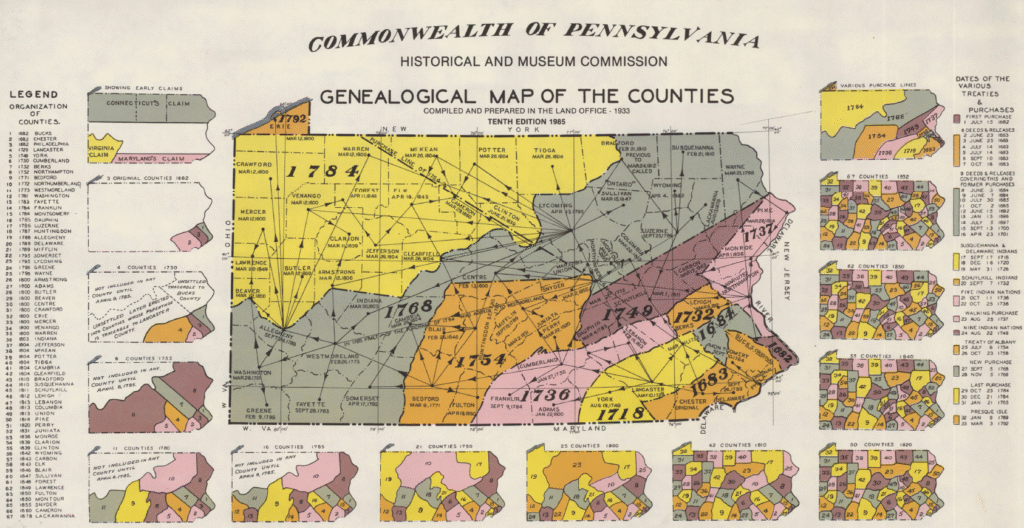
Today, Bucks County looks much like its 1682 counterpart in size and shape, but at one time, it was significantly larger! As Pennsylvania grew, land deeds formally expanded Bucks County north, covering what is now Northampton and Lehigh Counties. Some maps indicated that the entire northeastern corner of Pennsylvania, though unsettled, was traceable to Bucks County. This is likely because when Northampton County was created, it was to be taken from parts of Bucks County. When it was formed in 1752, Northampton County covered all of Wayne, Pike, Monroe, Carbon, Lehigh, Susquehanna, Lackawanna, Wyoming, Luzerne, and Sullivan Counties, as well as parts of Bradford, Lycoming, Columbia, and Schuylkill Counties, implying that all that land was considered Bucks County.
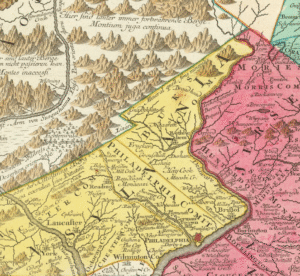
1756 Map of Bucks County
Originally inhabited by the Lenape, European habitation of Bucks County began in the 17th century with small settlements by the Dutch, Swedish, Finnish, German, and then English. In 1667 (or 1668, depending on the source), Governor Nicholls of the Province of New York granted land to Peter Alrichs (also seen spelled Alricks) that consisted of an island near modern-day Bristol. It’s unknown if Alrichs ever actually lived there, and the land was conveyed to Samuel Borden in 1682, and later to Samuel Carpenter in 1688. It is believed that a narrow channel of water separated this land from the mainland, and at some point, the water drained and the area became meadow land below Bristol.
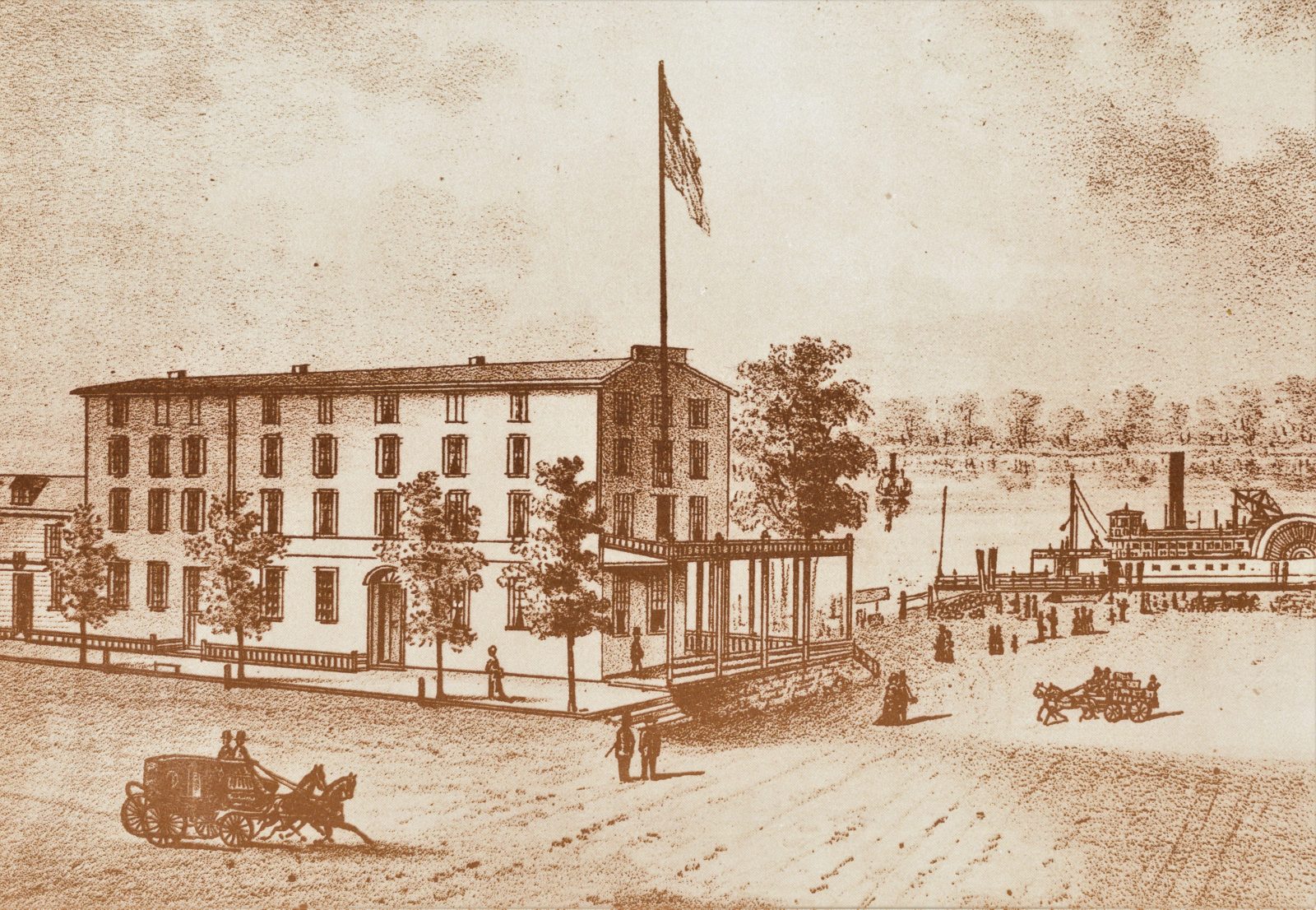
King George II Inn
Bristol, Bucks County’s first borough, was formed in 1681 by Samuel Clift and was first called Buckingham. Clift acquired a grant of 262 acres of land across the river from Burlington, New Jersey, and after setting up residence there, established a ferry crossing. He also set up a hotel called the Ferry House, which has been in continuous operation since. The original building was replaced in 1765 and is now known as the King George II Inn.
Earlier settlements did exist though, with one of them being in the area of Morrisville. The area was a trading post for the Dutch West India Company in 1624. It was also the site of Crewcorne or Crookhorne, a 1679/1680 English settlement that served as Bucks County’s first county seat from 1683 to 1705. The second county seat was Bristol, from 1705 to 1726 (some histories indicate that Bristol was the first county seat). Then the county seat moved north to Newtown, where it remained until county residents petitioned to change the county seat to a more centralized location. The act was approved in 1810, and the county seat officially moved to Doylestown in 1813, where it remains today.
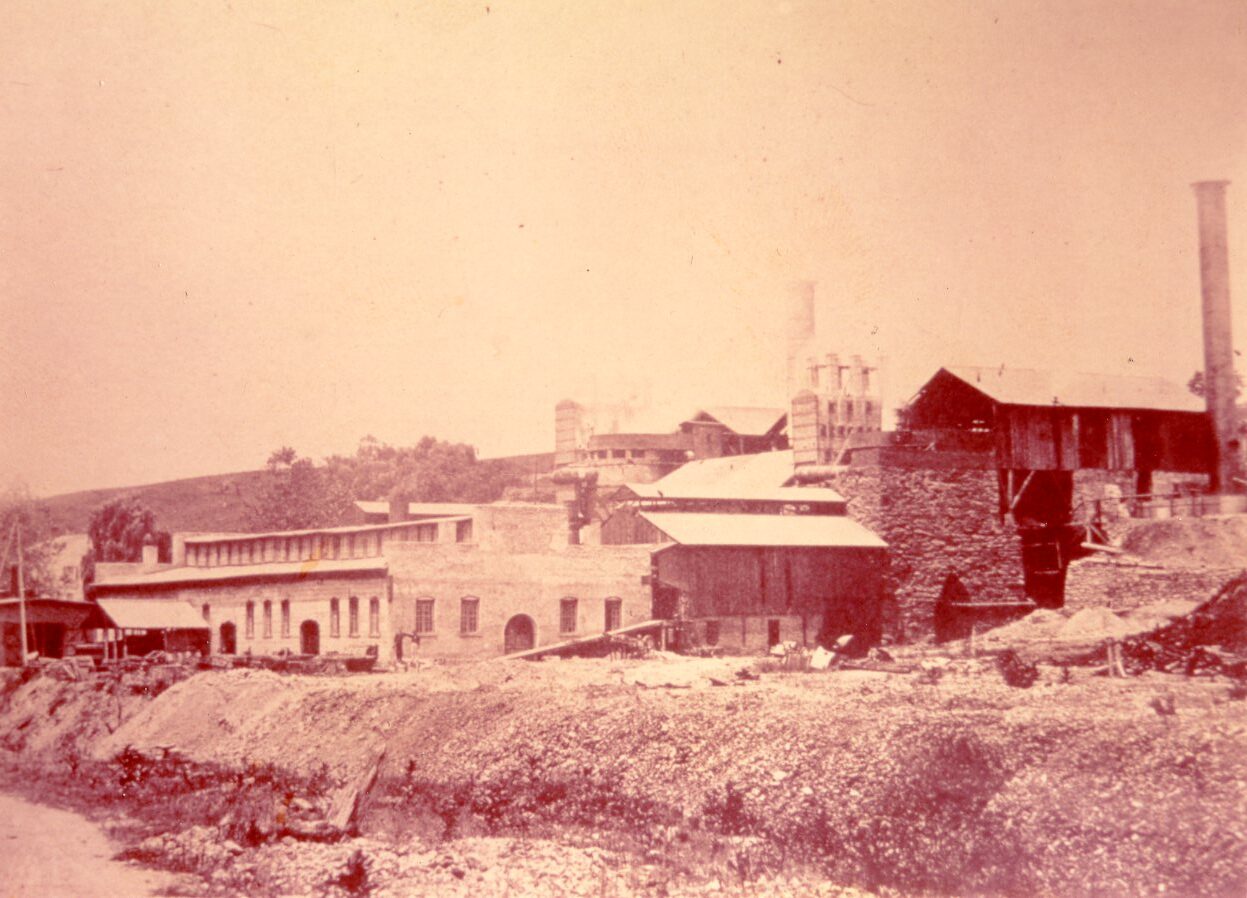
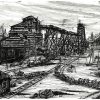
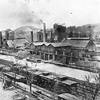
Durham Iron Works
Although Bucks County’s primary industry was agriculture, it became a major participant in the iron industry with the formation of Durham Iron Company in 1727. There are even reports of earlier smelting there. Durham, located on the northern tip of the county, was situated near iron ore, limestone, timber, and the running water of the Delaware River, making it the ideal spot for the first blast furnace in the Corridor. In the late 19th century other industries took root, and soon there was cigar manufacturing, textiles production, paper mills, shipyards, tileworks, and steelworks. At the same time, Bucks County’s interior remained largely rural. In fact, Bucks was home to two major heritage seed companies, Landreth and Burpee. Landreth, founded in 1784, moved to Bucks County in 1847, moving away in the late 1900s. Burpee was founded in 1876, moved to Doylestown in 1888, and is still headquartered in Warminster Township! Many Bucks County industries made their homes along the eastern shore of Bucks County due to the proximity to the Delaware River. They could utilize the water of the Delaware River to power their mills, and the river and Delaware Canal provided water transportation routes that carried their products across the United States.

Bucks County Playhouse
In the 20th century, arts and culture exploded in Bucks County. Pennsylvania Impressionism, an art movement from the early to mid-1900s, flourished in and around Bucks County. Also known as the “New Hope School”, many artists of this movement lived or painted near New Hope. Bucks inspired playwrights and authors like Doylestown native James Michener and Pearl S. Buck, a West Virginian who made her home in Perkasie. Actors and composers could be spotted around New Hope, with many joining summer stock productions at the Bucks County Playhouse.
From agriculture, to iron and steel, to the arts, Bucks County continues to grow and evolve.
Resources
“Burpee Beginnings”, “History of Innovation.” Company History. https://www.burpee.com/company-history
Capwell Fox, Martha. Geography, Geology, and Genius: How Coal and Canals Ignited the American Industrial Revolution. United States, Canal & History Technology Press, 2019.
Davis, William Watts Hart. The History of Bucks County, Pennsylvania: From the Discovery of the Delaware to the Present Time. United States, Democrat Book and Job Office Print, 1876.
Davis, William Watts Hart, et al. History of Bucks County, Pennsylvania: From the Discovery of the Delaware to the Present Time. United States, Lewis Publishing Company, 1905.
“Facts & Figures.” Visit Bucks County. www.visitbuckscounty.com/press-room/about-bucks-county/facts-and-figures/.
Green, Doron. A History of Bristol Borough in the County of Bucks, State of Pennsylvania: Anciently Known as “Buckingham”; Being the Third Oldest Town and Second Chartered Borough in Pennsylvania, from Its Earliest Times to the Present Year 1911. United States, C.S. Magrath, 1911
Pennsylvania, a History. United States, Lewis Historical Publishing Company, 1926.
“The Durham Charcoal Iron Furnace, 1727-1789.” History of Durham Township. www.durhamhistoricalsociety.org/durham-iron-furnace-1727-1791/.
Join the Conversation!