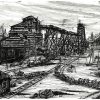












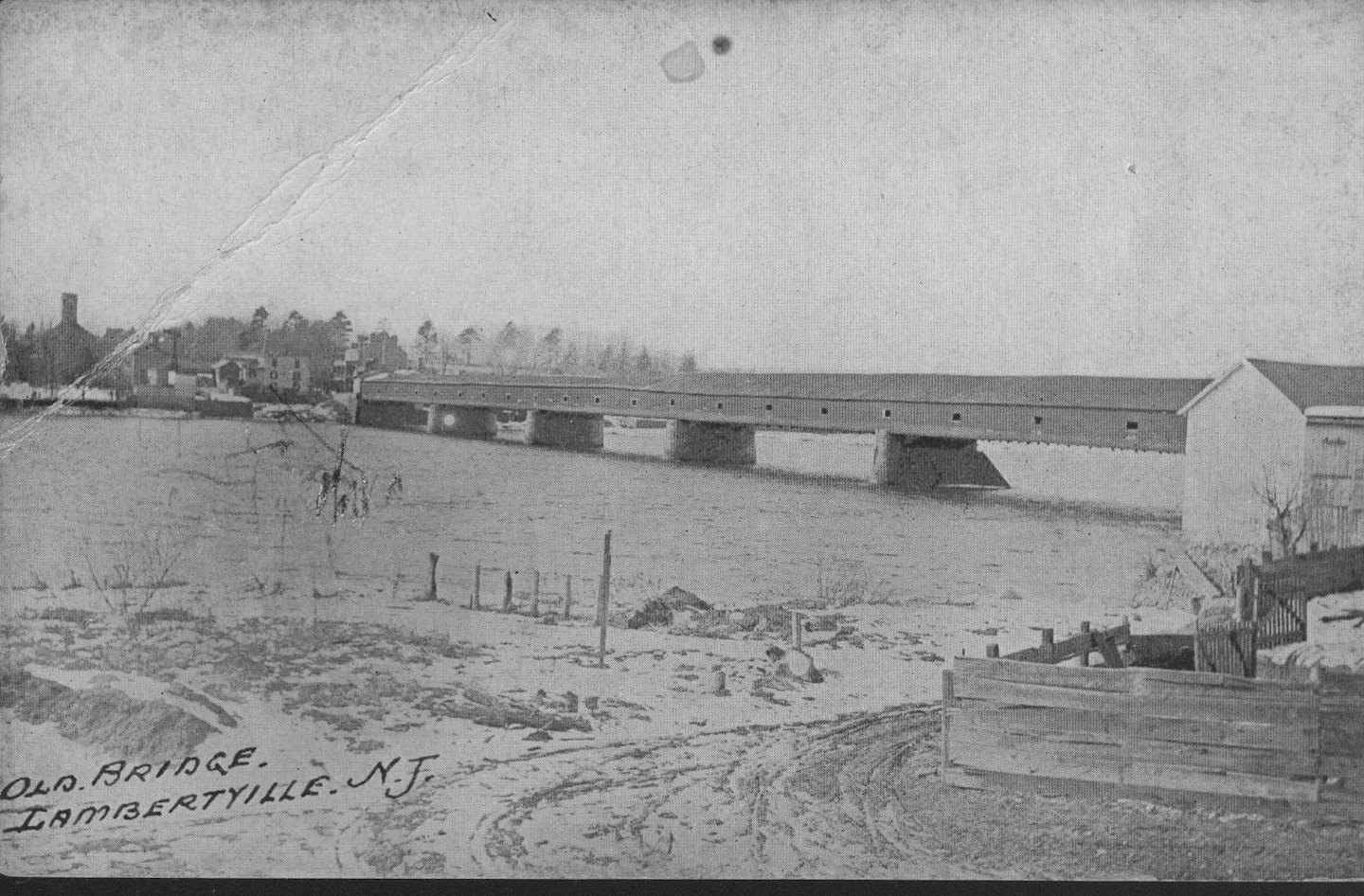
The New Hope-Lambertville Bridge after 1842. Sections on the Pennsylvania side of the bridge were still intact after the Freshet, so only the few sections on the New Jersey side were rebuilt.
The Freshet of 1841
Written by Wendi Blewett, DLNHC Museum Collections Manager
The Delaware and Lehigh Rivers are no strangers to flooding. Floods and freshets have plagued rivers since before recorded history, but stories from the freshet of January 1841 would be unbelievable if not for the people who survived it.
Unprecedented Flooding Across Pennsylvania’s Waterways
From the West Chester “Village Record”, dated January 12, 1841:
“A Narrow Escape: Among the incidents of the late freshet in the Delaware, one is the narrow escape of George Fell, of Centreville, above New Hope. He was standing on the bridge at that place, looking at the turbulent waters, when crash went the bridge and he along with it, and dashing down the current on one of its timbers, he was carried under and past New Hope Bridge, and was not extricated from his perilous situation until he reached Yardleyville a distance of 16 miles from where he started, a few minutes afterwards the New Hope Bridge itself was cut into; the Centreville bridge going clear through it, carrying away three arches and two abutments.”
George Fell, a Centreville storekeeper, was crossing the bridge to act as a substitute toll keeper when the rush of water hit the bridge, breaking it apart and plunging him into the Delaware. He was able to gather some timber, creating an ersatz raft, and stay afloat as he careened downstream. At New Hope he lay flat on his back to avoid hitting the covered bridge there, and he and his raft passed safely underneath and continued downward. Shortly after he passed, pieces of the Centre Bridge smashed into the covered bridge, destroying several sections. Mr. Fell went over Wells Falls, and upon reaching the covered bridge at Taylorsville (Washington Crossing) was miraculously submerged beneath the bridge, surfacing on the other side without serious injury. He was finally rescued near Yardleyville (Yardley) by a man who was able to pull Fell into a boat and land on the New Jersey side of the river.
The Delaware Bridges Destroyed
In another article from the same newspaper, it was written that all the bridges of the Delaware were damaged or destroyed in the freshet. This freshet is also known as The Bridges Freshet, for good reason.
The bridges on the Lehigh suffered a similar fate. The Lancaster Intelligencer of January 19, 1841 reported on damage on the Schuylkill, Delaware, and Lehigh. Of the Lehigh, the newspaper wrote, “As far as heard from not a bridge is left upon the Lehigh. Those at Stoddartsville, Lehighton, Siegfrieds, Allentown, Bethlehem, Freeman’s and Easton, are all swept away.”
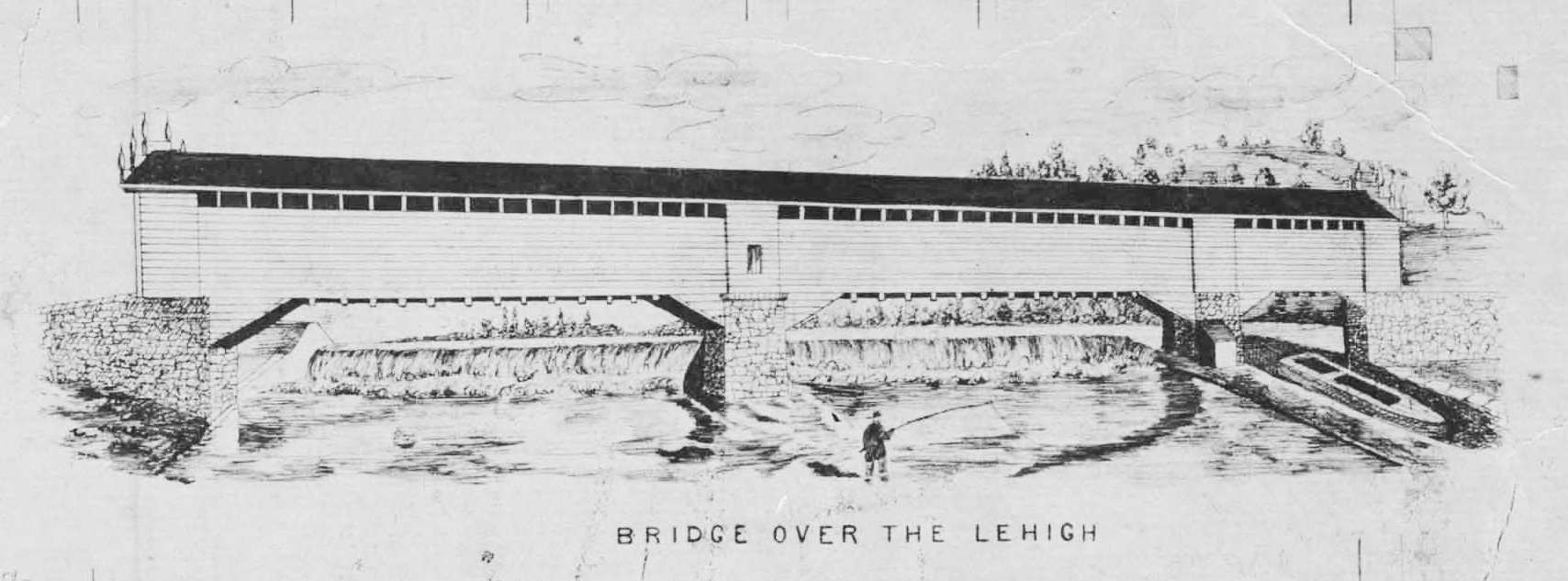
The second bridge over the Lehigh at Hamilton Street in Allentown, built after the first was destroyed in the Freshet of 1841.
Mauch Chunk Underwater
In Mauch Chunk (Jim Thorpe), the damage was devastating. Again, from the January 12, 1841 issue of the West Chester “Village Record”:
“Disastrous Flood – Loss of Human Life: Mauch Chunk, Jan 7, 1841. Thursday evening, 11 o’clock – One of the most awful and tremendous freshets that has ever happened in this part of the State has taken place here: It commenced raining last evening, and has not ceased yet. There will be few closed eyes in Mauch Chunk this night – Our town is all afloat. There is a mighty torrent running the whole width of the main street some six feet deep. On one side the inmates have left the lower story and taken to the second for safety: It is an awful night. House after house is going down the Lehigh. All three of the saw mills have gone. Two stone stables at the hotel also gone, with the bridges, etc. All the canals, locks, etc, gone. Whole houses are passing. One of the large packet boats broke loose, and passed down close to the piazza of the hotel, which is two stories high. What the damage is below we dare not think of. We fear ere tomorrow’s dawn many valuable citizens will have found a watery grave. Friday evening – Our darkest forebodings have been more than realized. All our beautiful navigation, above and below, is swept away. Dams, locks, lock-houses, inmates and all, are gone. Those tremendous locks are entirely swept away. The bridges above and below are gone. The large railroad bridge at the end of the Narrows, the one at Lehighton, Gap, etc., are all gone. Out of twenty houses, from Squire Sayres to Lehighton, but four remain; and very many of the inmates are gone with them.”
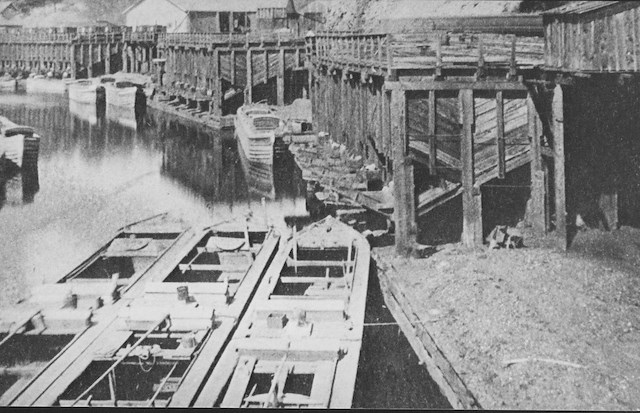
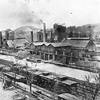
The coal loading docks at East Mauch Chunk, built after the freshet damaged the coal wharves on the Upper Grand.
Damage to the Lehigh Canal
Later articles indicated that the damage to the Lehigh Canal was not so severe as to call it ‘swept away’, but that there were washouts on the towpath and embankments as well as damage to locks and structures. Lehigh Coal & Navigation was alerted to the damage on January 10th, one day prior to their annual stockholder meeting. They quickly assigned engineer E. A. Douglas to survey the damage, and by February 16th produced a supplementary report to their 1840 Annual Report that called the reports of damage “greatly exaggerated rumuors.” Details from Douglas’ report estimated that complete repair of both the lower and upper sections of the Lehigh Navigation would cost $320,059.44. The lower section, from Easton to Mauch Chunk, was repaired enough by July 10th, 1841 that boats were able to travel safely. An unanticipated rise in the water of the Lehigh delayed repairs to the upper section of the Lehigh Navigation, from Mauch Chunk to White Haven. Coal wharves were installed at East Mauch Chunk to allow the delivery of coal from the Beaver Meadow Railroad Company, the Hazleton Company, and the Sugar Loaf Company, as these companies had previously been delivering coal to the canal along the upper section.
Like the Lehigh Canal, the Delaware Canal also suffered washouts along the towpath and embankments and damage to locks, dams, and structures. Repairs made it possible to accept boats by July 1841.

Join the Conversation!