












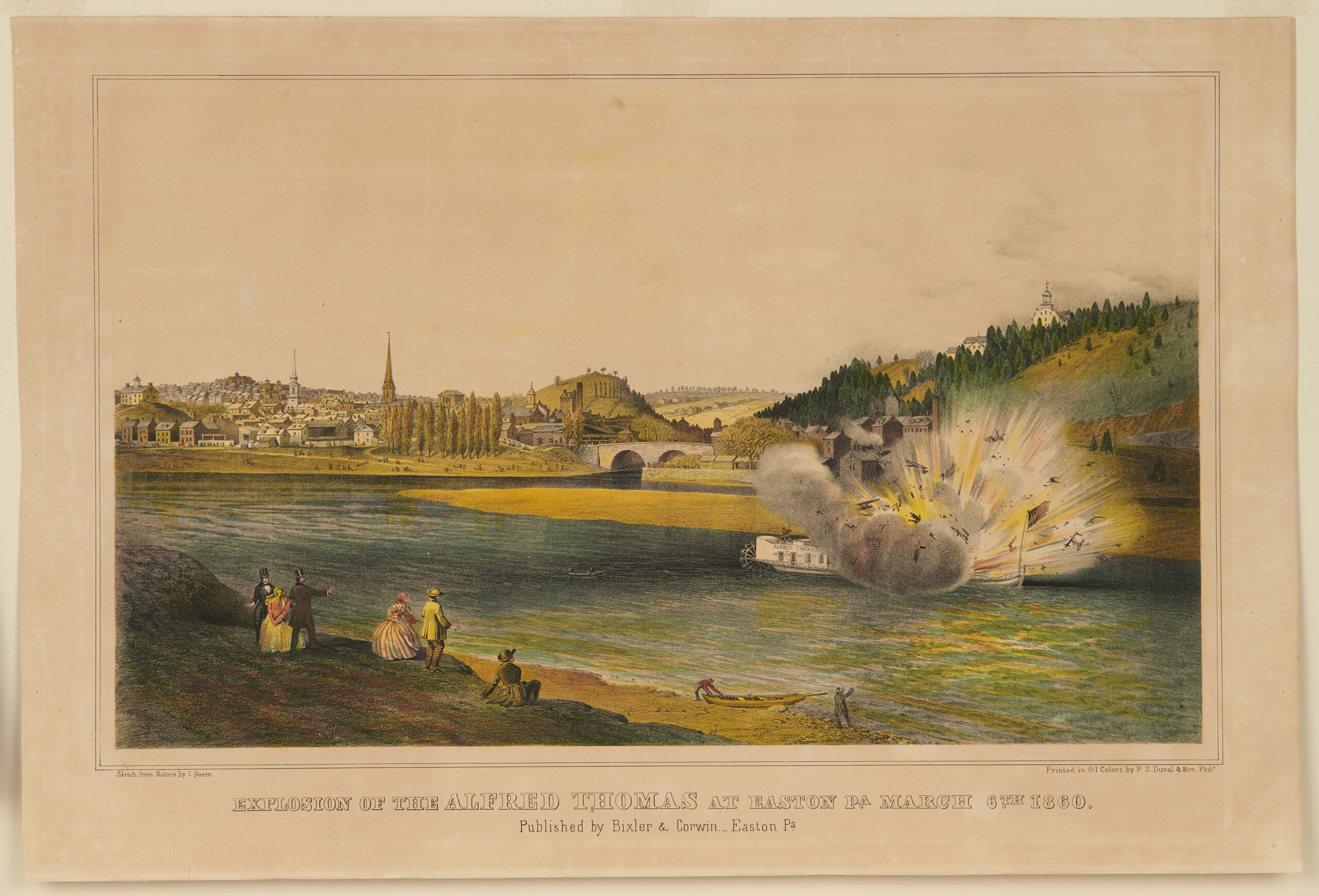
Queen, James. Explosion of the Alfred Thomas at Easton Pa. March 6th 1860. 1861. Lithograph. Palmer Museum of Art, The Pennsylvania State University, University Park, PA. Click to enlarge image.
Disaster on the Delaware
Written by Carter Drake, DLNHC Museum Coordinator
On the 6th of March one hundred and sixty-six years ago, a nearly ninety-foot steamer, Alfred Thomas, was bound for Port Jervis, New York. The ship was built in Easton, with the intention of ferrying passengers between Port Jervis and Belvidere, New Jersey, along the Delaware River. While it was not the first steamer to attempt to travel on the river, it was believed the rapids north of Easton made that portion of the Delaware unnavigable.
Investors from Belvidere wanted to expand steam travel on the river, designing the Alfred Thomas to navigate through the shallow and rocky portion of the river known as Foul Rift. Once the obstacle was cleared, it should have been a smooth trip the rest of the way.
Its owners Judge William Sharp (also spelled Sharpe) and Richard Holcomb (also spelled Holcom or Holcombe) were in attendance for its maiden voyage. The launching of the Alfred Thomas became an event for the residents of Easton. Many of the citizens of Easton put on their best and gathered on the river’s bank to watch the ship pass by. However, not all believed the day would go well. The ship’s builder, Thomas Bishop, believed they were setting themselves up for disaster. Bishop was convinced that the ship’s engineer Samuel Schaeff (also spelled Shaeff or Schaef) was out of his depth. Fearing an incorrectly installed boiler would lead to an incident, Bishop refused to get on board, to the chagrin of the Alfred Thomas’s investors, who believed the refusal of the ship’s builder to climb aboard would send the wrong message to the public. Unconvinced, Bishop refused the urgings of Sharp and Holcomb, and the Alfred Thomas set off northbound without him.
The Wayne County Herald claims that she “ran very well, until she reached the strong current in the eddy near Able’s (today Getter’s) Island.” It was here that the inadequacies of the boiler became apparent. The engineer and others on board realized that the ship would require full steam (maximum power) to make it through the eddy. Upon their first attempt, the crew realized they were not going to make it, and about halfway through the eddy, they decided to drift with the current downstream and try to reach full steam once more.
Then disaster struck.
The New-York Tribune lays out the disaster as follows:
“The space between the upper flues and the dome of the boiler was too small to have a sufficient quantity of steam and water on hand to keep up the requisite motive power. The consequence was, that when, therefore, the boat did not succeed to get through the rapids at her first trial, her steam got too low and she had to lie for a time. Steam was then generated, and the flues became heated almost to red heat, until the pressure … was 125 pounds to the square inch. The order was given to set the engines in motion, cold water was pumped into the boiler, and, from the shaking of the boat, it came into contact with the over-heated flues, and the explosion was the inevitable result.”
The boiler was nowhere near capable of handling that level of pressure. With the flues glowing near red heat and the gauge climbing past 125 psi, the engines were thrown into motion and the feed pumps sent a rush of cold water into the starved boiler; as the hull sloshed it against the scorched iron, it flashed instantly to steam, and the overtaxed shell, never built to hold such a force, burst apart in a single thunderous explosion, hurling fragments of iron, timber, and scalding vapor across the deck and river. The resulting explosion instantly killed ten passengers, including the ship’s engineer Samuel Schaeff and his son George who according to the New York Tribune “was killed at his post, having a greater part of his head carried away by a portion of the boiler”. Judge Sharp and Richard Holcomb were also killed in the blast. Fourteen additional passengers sustained serious injuries, with two of the wounded succumbing to their injuries in the following days. Witnesses reported the explosion throwing passengers upwards of twenty feet into the air, some landing unharmed; others were maimed and drowned in the river. The scene on the ground was equally hectic. Hundreds of bystanders on the shore witnessed the scene unfold; some of whom assisted victims swimming to shore. Frantic spouses patrolled the beach, desperate to learn the fate of their loved ones. One paper describes the scene as a beach strewn with limbs and disfigured passengers, while the women of Easton hurriedly sought out their husbands and sons. Easton has never since seen such a traumatic incident, and the legacy of the Alfred Thomas explosion effectively ended attempts to pursue steam travel in the northern reaches of the Delaware. The irony was that this disaster could have been easily avoided if Thomas Bishop’s advice had been heeded. Historian Lance Metz explained in an interview with WFMZ’s Jane Moyer that the technical knowledge around steam boilers had still yet to fully reach the Easton area. Contemporaries also pointed out the preventability of the incident. A scathing report in Scientific American noted that local engineers lacked the specialized expertise to build or manage high-pressure boilers safely for such violent waters. The writer sums up his report on the incident saying, “There is no mystery as to the cause of this explosion; the boiler was managed as with an intent to commit suicide.” The explosion of the Alfred Thomas may be one of the most morbid incidents to have occurred in Easton, but it illustrates the challenge of utilizing emerging technologies and the inherent risk of doing so. The lessons learned from the ship’s fate prevented the expansion of steam transportation and perhaps assisted in the continued use of the Navigation System for years to come, as the safest means of transport at the Forks of the Delaware.
Sources
Moyer, Jane S. “Alfred Thomas Explosion Shattered Easton in 1860.” WFMZ.com, 5 April 2011
“Terrible Accident.” Lancaster Intelligencer. 13 March 1860, p. 2. Newspapers.com.
“Terrible Disaster.” Wayne County Herald. 1860. 15 March 1860, p. 3. Newspapers.com.
“The Steamboat Explosion on the Delaware.” The Times-Union. 9 March 1860, p. 4. Newspapers.com.
Whelan, Frank. “Alfred Thomas Explosion Shattered Easton in 1860.” WFMZ.com, 10 June 2011


Join the Conversation!